Sunday, June 26, 2005

Pope Benedict and Father Leon Dehon

This past week we learn that Pope Benedict XVI was acclaimed by The Jewish Week by his decision to halt the "fast track beatification" of French priest Father Leon Dehon (1843-1925) due to allegations of anti-semitism, prompting a formal inquiry by the Church (Important Gesture by Pope Benedict, by James D. Besser. The Jewish Week June 17, 2005).

The beatification of Fr. Dehon by Pope John Paul II was scheduled on April 24, 2005 during the Eucharistic celebration in St. Peter’s Square. Jews took the Holy Father's move as a sign of his sensitivity to important issues in Jewish-Christian relations and that he would carry on his predecessor's commitment to fostering good relations between the Church and the Jewish people:

"This is exceedingly important," Rabbi Gary Bretton-Granatoor, interfaith director for the Anti-Defamation League, told The Jewish Week.

Rabbi Bretton-Granatoor was part of a 25-member Jewish delegation who met with the new pope last week. "This gesture is much appreciated and bodes well for the future," the rabbi said. . . .

Earlier this year, historians in France uncovered anti-Semitic writings by Father Dehon, who died in 1925, including his contention that Jews are “united in their hatred of Christ” and that the Talmud is a “manual for the bandit, the corrupter, the social destroyer.”

The hold on beatification — which was not a result of last week’s meeting with the Jewish delegation — also could point to a new Vatican sensitivity on other outstanding issues between the two communities, including the drive to elevate Pope Pius XII, the Holocaust-era pontiff, to sainthood.

“If this means they would consider slowing down the process on Pius XII until all the records are made available and analyzed, that would be a very good thing,” Rabbi Bretton-Granatoor said. “That is an issue we have raised repeatedly. We will have more opportunities to raise it again when we are there in September and October.”

Further discussion can be found, of course, at Amy Welborn's blog ("Second Thoughts" June 10, 2005), where the commentators appear divided regarding the decision, with some proposing that the priest's sentiments should be taken in light of the historical context, especially given the fact that past Christian saints have also expressed claims about the Jews that could be judged anti-semitic in content.

Others question the basic prudency of beatifying any Catholic who expresses anti-Jewish opinions following the Holocaust, especially since, in the rise of anti-semitic incidents in Europe and worldwide, they may be fuel for misinterpretation and confusion regarding the Church's relationship with the Jewish people. Sandra Meisel muses:

The newspaper account says that this cause had been closed on account of the candidate's anti-Semitism in 1952. His attitudes were well known in France. So who saw fit to revive the cause and why? To catch the rising wave of European anti-Semitism? And why would the late Pope approve this, given his warm feelings toward Jews? Was information witheld?

Yes, we'd had anti-Semitic saints in the past, including St. Louis IX and St. John Capistrano. One would think this would be an easy call, post-Holocaust, but the Church recently ignored anti-Semitic elements in Anna Catharina Emmerich -- who made the blood libel -- and beatified her. We should be most grateful that this cause was stopped in time.

I don't see how one can impute deceptive motives on the part of Dehon's supporters in making their case for beatification. After reading about his life and vocation on the website of The Priests of the Sacred Heart, you see there is much one can admire: his devotion to Christ in prayer and veneration of the Eucharist, his solidarity with the poor and working class, his recognition of the "inalienable dignity" of every human being by virtue of their God-given soul ("whether in the body of a worker at the bottom of a dark coal mine, or in the body of a well-fed financier living in the lap of luxury").

According to the SCJ's vocation website, there are approximately "130 SCJ priests and brothers living and working within the United States [and] about 2300 SCJ priests and brothers world-wide," seeking to be "prophets of love and servants of reconciliation" in carrying out a variety of ministries in the world (including, for example, a ministry to the Native Americans from South Dakota to Wisconsin, Mississippi, Illinois, Florida and Texas).

In their defense, it is completely understandable that they would harbor a particular affection for the life and vision of their founder, and wish to see him recognized as a saint. Pope John Paul II also recognized the worth of their charism in his address to the Priests of he Sacred Heart of Jesus (Dehonian Fathers) on June 10, 2003:

This year is the 125th anniversary of religious life of Venerable Léon Dehon. You have wished to commemorate it with a special Dehonian Year that ends on 28 June, the day when you will be commemorating his first religious profession. He himself recognized it as the day on which your Congregation came into being. I hope that this will be an incentive to you to go back to your origins with that "creative fidelity" (cf., Vita Conscrata, n. 37) which will keep intact your charism, distinguished by constant contemplation of the Heart of Christ, conscious participation in his reparative sacrifice and zealous dedication to spreading the Kingdom of the Lord in souls and in society, since it is precisely the rejection of God's love which is the root cause of the evils in the world (cf. Constitutions, n. 4).

However, one must recognize the fact that whatever qualities are good and worthy of admiration in Fr. Dehon, his perception of the Jews in those statements attribute to him are indeed hateful and indefensible, justly meriting condemnation by the Church. And for that reason I concur with those questioning the prudency of such a beatification and the consequent decision of the Holy Father in calling for a formal investigation of the matter. To quote Lee Podles (on Amy's blog):

The poison of anti-Semitism has to be purged from the Church. The beatification of a recent figure who made such anti-Semitic statements would hinder this necessary purification. Can you imagine the legitimate furor if a German Pope canonized an anti-Semite, making excuses for the remarks?
* * *

According to the same article in the Jewish Week, the meeting of the Jewish delegation and Pope Benedict led some participants to speculate on the prospects of a more theologically-oriented dialogue between Jews and Christians:

"He’s a different person," [director of the Commission on Interreligious Affairs of Reform Judaism Mark] Pelavin said of Pope Benedict. "He's a theologian by training and practice. That will color the dialogue. I think it will be more theological in nature. There will be a greater exploration of the idea of the Jews’ covenant with God, and how that relates to Catholic covenantal thinking. Those are things that will have an impact not so much in the political arena but in the teachings the Church uses."

Rabbi Bretton-Granatoor said the meeting suggested Catholic-Jewish relations are poised to jump to a new level.

"After 40 years, the time has come for us to engage in mature theological dialogue," he said. "It’s time for us to recognize that we have very different ways of looking at texts; basic concepts like covenant and mission mean different things. This meeting signaled that it’s time to start unpacking those issues. We have to learn to celebrate our differences, not try to sweep them away."

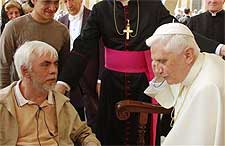
Several participants commented on Pope Benedict’s demeanor at the meeting.

"At the beginning he seemed as taciturn and as sharp in his bearing as I would have expected," said one. "But as soon as we were finished with the formalities and he stepped down to greet each of us individually, the warmth and kindness were unmistakable."

Related Links:

Pope Benedict XVI Roundup!

  • The usual line of criticism is that it's The Church that's preoccupied with sex, or "the pelvic issues." Not so, according to John Allen Jr.:

    Earlier this week, headlines in the American press reported that Pope Benedict XVI had attacked gay marriage. Though the statement fell into the "Dog Bites Man" category of utterly predictable news, it nevertheless illustrates how any pronouncement by an official of the Catholic church on a sexual topic will draw attention.

    One point perhaps worth noting: In his 48,978 words of teaching as of June 9, Benedict XVI had used the word "sex" exactly once, while the word "Africa," mostly in the context of an appeal for attention to the problems of Africa, appeared 11 times. It's no mystery which has been given greater prominence in the international press. . . .

    From the news coverage, one could get the impression that Pope Benedict's statement was primarily "about" gay marriage, since that's all that was quoted. In fact, the line above was one sentence in a 3,000-word speech delivered at a convention on the family for the diocese of Rome. The broader theme was the Christian concept of the family.

  • At audience, pope speaks on mobile phone, dons fire chief's helmet, by Cindy Wooden. (Catholic News Service June 15, 2005):

    A middle-aged man in a wheelchair, who was among dozens of people led up to the pope at the end of the audience, handed Pope Benedict a mobile phone and asked him to talk. The pope did so. . . .

    [Italian News Agency] ANSA later interviewed the cell phone owner, Emilio Testa, and the 44-year-old nun with cancer, Sister Maria Cristina, a member of the Sisters of St. John the Baptist in Angri, Italy.

    "When I heard his voice I could not believe it was Pope Ratzinger," the nun said. "I thought it was a dream, but instead it was real.

    "He asked me how I was, he told me to stay calm and that he would pray for me," she said. "The most surprising thing was that he remembered my name. He kept calling me Sister Maria Cristina, almost like we already knew each other."

    Testa told ANSA: "I knew how badly Sister Maria Cristina wanted to see the pope, but her health would not permit it. So when I saw the pontiff, I did not think twice. I got close, kissed his hand and, without pausing, asked him to pray for Sister Maria Cristina and perhaps say hello to her on the phone.

    "The pontiff immediately said 'yes,' took my cell phone and, smiling, began to speak to her," Testa said.

    "When it was all over, I started bawling like a baby. I realized that something extraordinary had just happened," he said. "I was happy because I knew that with that call Sister Maria Cristina's heart filled with joy."

  • In Search of Freedom; Against Reason Fallen Ill and Religion Abused, on the 60th anniversary of the Allied landing in Normandy. It was initially published in the German daily Frankfurter Allgemeine Zeitung and was translated from the German by Jeffrey Craig Miller. Logos Vol. 4, Issue 2 (Spring 2005). The Holy Father addresses on a number of pertinent issues: "the breakdown of the sustaining power of law" and the rise of terrorism ("in order that force in the defense of law and right shall not be itself do wrong, it must subject itself to stringent measures. It must pay heed to the causes of terror, which so often has its source in standing injustice"); the relationship of Islam and the West ("what is it, the West? And what is Islam? Both are multi-layered worlds with great internal differences - worlds that, in many ways, also intersect. In this respect, the crude antithesis West-Islam, does not apply"), political order ("Christian belief - following in the way of Jesus - has negated the idea of political theocracy. It has - to express it in modern terms - produced the worldliness of states, wherein Christians along with the adherents of other convictions live together in peace"). As usual, a very provocative essay and one worth discussing at length. I'll probably return to it in a later post but wanted to note it for the benefit of my readers.

  • Benedict XVI less conservative, more pastoral than expected: New pontiff warms to papacy, by Ann Rodgers. Pittsburgh Post-Gazette. June 13, 2005.

  • A friend noted recently in his email:

    Apropos of the compendium of the Catechism of the Catholic Church, in an interview in the April 2003 issue of 30 Giorni magazine, the then prefect of the Congregation for the Doctrine of the Faith, Cardinal Joseph Ratzinger, said that in some circles "there is a certain opposition to any attempt to 'crystallize' a doctrine in words, in the name of flexibility."

    "The post-conciliar catechetical movement accentuated the anthropological aspect of the question and believed that, if a catechism is too doctrinal, it would be an impediment to the necessary dialogue with the man of today," the future Benedict XVI noted.

    "We are convinced of the contrary," he said. "To dialogue well, it is necessary to know what we must talk about. It is necessary to know the essence of our faith. For this reason, today a catechism is more necessary than ever."

    As a veteran fighter of the liberal catechetical establishment in Australia, to hear words like that are music to one's ears. For so long the conventional wisdom here has been "Don't teach the kids doctrine, but good Christian living". Yeah, but orthopraxis proceeds from orthodoxy. How wonderful that the man who uttered the highlighted words is now the pope, and shared our concerns.

  • A new book by Cardinal Ratzinger entitled The Europe of Benedict: In the Crisis of Cultures was published this past week in Italy, according to Catholic World News ("Pope's new book affirms Europe's Christian roots" June 22, 2005). The book was introduced in Rome on June 21, at a press conference chaired by Cardinal Camillo Ruini, vicar for the Rome diocese, who discussed the themes of the book:

    Cardinal Ruini, in introducing the book, told reporters that Pope discussed "the fundamental points of European culture in relation to Christianity," adding that the faith remains a dominant formative influence on European society.

    The ties between Europe and the faith, the cardinal continued, "today are at risk of being broken, not by accident" but through the influence of an aggressive secularism. Cardinal Ruini spoke of an ideology which believes that "God does not exist, or at least doees not have to be accepted, and thus no reference to Him can be made in public life."

    The Italian prelate added that in the book, Pope Benedict/Cardinal Ratzinger appeals to lay Catholics to combat the spread of that ideology, and to "orient their lives as if God exists.

    The three speeches contained in the Pope's new book are "What it Means to Believe," delivered in 1992 at Bassano del Grappa, Italy; a talk on "The Right to Life in Europe," delivered at a pro-life conference in 1997; and a speech on "The Crisis of Cultures," delivered on April 1 of this year-- the eve of the death of Pope John Paul II at Subiacco, where St. Benedict founded his first monastery in the 6th century, as Cardinal Ratzinger received the "St. Benedict for Europe" prize.

    Catholic News reports that "shortly after his election, the Pope assigned all the rights to his works to the Vatican publishing house, Libreria Editrice Vaticana" -- I'm curious as to how this affects the Pope's relationship with Ignatius Press, which was the authorized translator / publisher of the Holy Father's books in English?

  • On the subject of books, Zenit News Service interviewed Ave Maria University's Father Matthew Lamb, discussing Joseph Ratzinger's "Primer on Ecclesiology": Called to Communion -- Part I ; Part 2. June 23/24, 2005.

  • Finally, for all the clubbers out there, Jamie McMorrin gives us Pope Benedict XVI: The Dance Mix - "a re-mix of the announcement from that glorious day when our Holy Father ascended the throne of Peter." =)

Monday, June 06, 2005

Pope Benedict XVI Roundup!

  • The Promise of Benedict XVI, by Timothy George. The Dean of Beeson Divinity School of Samford University, thinks that:

    "John Paul II will long be remembered as the greatest pope since the Reformation. His successor, Benedict XVI, may well turn out to be the harbinger of a new reformation. . . .

    I am not predicting that Benedict XVI will follow suit and preside over a new council, Vatican III. But I do believe his pontificate will be one of great moment for the Christian church, not least for evangelicals.

    George offers five reasons why "evangelical Protestants, and orthodox believers of all persuasions, should be pleased at the election of Pope Benedict XVI." Take a look.

  • "I Don't Think Benedict XVI's 'Program' Is to Combat Relativism" Zenit interviews Journalist Andrea Tornielli of Il Giornale. May 22, 2005:

    Just as I avoid the caricature that certain progressive environments have made of Ratzinger over the past 20 years, I also try to be on guard against a certain error: to think that he will be a Pope on the basis of what Cardinal Ratzinger, prefect of the Congregation for the Doctrine of the Faith, was and said.

    I don't think that Benedict XVI's "program" is to combat relativism. I believe, instead, that he will seek to proclaim and witness the simplicity, purity and beauty of faith in Jesus Christ.

    The antidote to relativism is not a program, it is not a theory, it is not and can never be an invective or a denunciation. An invective, a denunciation, however, were more useful vis-à-vis communism. No, the antidote is in a people, even small in number, that lives the faith and witnesses the fullness of life.

  • In his latest Word from Rome, John Allen Jr. assesses the first 45 days of Pope Benedict XVI's pontificate:

    The pope has been more critical in describing negative trends in the broader culture. Yet so far, the overwhelming tone of his teaching has been positive, rather than the condemnation of error. Benedict XVI may prove to be less censorious than many had expected.

    Second, it's interesting to note that despite Cardinal Joseph Ratzinger's frequent criticism of what he described as hasty or excessive reforms following the Second Vatican Council (1962-65), Vatican II is by far the most-cited source in Pope Benedict's teaching other than his immediate predecessor, John Paul II. So far, the pope has explicitly cited Vatican II fifteen times. That seems a signal that Benedict, who was a peritus, or theological expert, at Vatican II, intends to align himself with the council, at least as he understands and interprets it.

    After presenting five "big ideas" that have distinguished themselves in the Holy Father's words to date, Allen turns to Benedict "as governor," as "collegial pope," and thoughts on his style of leadership. An interesting development from one who had formerly portrayed the Pope as "The Vatican's Enforcer."

  • Pope Catholic - Media Shocked! - Jeff Miller aka. The Curt Jester critiques the media response to an address by Pope Benedict XVI, in which he reiterated basic Catholic teaching on a number of moral issues. The MSM (Mainstream Media) took it as a revelation that the Pope is not as cute and cuddly as they had hoped for.

    Further commentary on condemnation of "pseudo-marriages" by Dave Morrison (Sed Contra).

  • Last Saturday the Holy Father celebrated the 28th anniversary of his episcopal ordination:

    Father Joseph Ratzinger, a member of the International Theological Commission, was appointed archbishop of Munich and Freising by Pope Paul VI on March 24, 1977, and received episcopal ordination from the hands of Bishop Josef Stangl of Wuerzburg the following May 28.

    Father Ratzinger, who had just celebrated his 50th birthday, became the first diocesan priest in 80 years to assume the pastoral governance of the large Bavarian archdiocese. Paul VI elevated him to cardinal just a month later, on June 27.

    In his autobiography "Milestones: Memoirs 1927-1977" (Ignatius Press, 1999), Cardinal Ratzinger recalled the date of his episcopal consecration as "an extraordinarily beautiful day," "a radiant day at the beginning of summer, on the vigil of Pentecost of 1977."

  • "The Sacrament of Unity" translation of the homily Benedict XVI gave today in Italian during the closing Mass of the 24th Italian National Eucharistic Congress, in the esplanade of Marisabella. Zenit. May 29, 2005. According to Zenit News Service, "the Eucharistic congress, which has gathered representatives of all the ecclesial entities of Italy, opened with the theme "We Cannot Live Without Sunday." The theme is taken from the words expressed by the 49 martyrs of Abitene, a city of the Roman province of Proconsular Africa, today's Tunis, in the year 303, during the persecution of the emperor Diocletian."

  • Oswald Sobrino @ Catholic Analysis on "Ratzinger on Eucharist and Parousia":

    "Parousia" is the Greek New Testament term meaning "presence" that is used to refer to the Second Coming of Christ. In a popular EWTN video series by Scott Hahn and Mike Aquilina, Hahn speaks of the Eucharist as an experience of the parousia, both in the sense that Christ comes in the Eucharist and in the sense of looking forward to Christ coming again at the end of the age. Hahn notes in the video series that the ancient Christian Aramaic prayer "maranatha" is both a plea of "Come, Lord Jesus" and a proclamation that the Lord Jesus has already come.

    Well, back in 1977, theologian Joseph Ratzinger, as he embarked on his career as a bishop, made the very same observation . . .

    [UPDATE: Ratzinger, Parousia and the Eucharist - a continuation of the previous post].

  • Writing on the pernicious effect of relativism on Christian missions, one encounters this little display of what I believe is the Holy Father's sense of humor:

    The dogma of relativism has, however, yet another effect: Christian universalism, which is carried out concretely in mission, is no longer the obligatory handling on of a good meant for everyone, that is, of truth and love; with this presupposition, mission becomes the mere presumptuous attitude of a culture that imagines itself to be superior, that tramples upon a whole multitude of religious cultures in the most shameful fashion, thus, it is held, depriving these people of what is best: their own heritage. Thence comes the imperative: Give us back our religions, as the right ways for the various peoples to come to God and God to them; where these religions still exist, do not touch them! Is this demand appropriate? It is at any rate there that the good sense, or nonsense, of the dogma of relativism in the sphere of cultures and religions must be demonstrated.

    At least, in the face of such demands, one ought to look carefully at each religion to see whether its restoration would really be desirable. When we think, for instance, of how on the occasion of the most recent rebuilding of the main Aztec temple, in the year 1487, "at the very lowest estimate, twenty thousand people" bled to death, "over four days, on the alters of Tenochtitlan" (the capital city of the Aztecs, in the upper Mexico valley) as human sacrifices to the sun god, it would be difficult for us to encourage this restoration of religion. . . . To the earth gods and the vegetation gods, the Aztecs offered "men and women, who were for the most part flayed alive"; to the gods of rain, who were thought of as being like dwarfs, they offered up little children, who were drowned in springs, in water holes, and in certain parts of the Lake of Tetzcoco. There were rituals, a part of which was the slaughter of human beings. All of this derived, as W. Krickeberg has established, not from some inborn "inclination to bloodthirstiness", but from a fanatical belief in the duty of men to provide in this fashion for the continuation of the world. This, of course, is an extreme instance, but it nonetheless shows that one cannot simply see in any and every religion the way for God to come to man and man to God.

    From Truth & Tolerance: Christian Belief and World Religions pp. 73-75 (Ignatius, 2004). According to Ratzinger, differing variants of the lecture from which this was excerpted was read at the Salzberg Higher Education week in 1992, at a meeting of the CDF with the Asian Bishops Conference in 1993, and at an educational function in Sassari (Sardinia). I must say I'm curious whether the above passage made it into the lecture? =)